By Lisa Hagen
Tammy Rodriguez was taking a step back from her front-facing role of advocating for federal online protections for children when she got a call from the Connecticut attorney general’s office in late August.
She was asked to attend a press conference the following day but received only vague details. Rodriguez has worked on the issue of online safety since the death of her 11-year-old daughter, Selena, in 2021.
When she traveled from Windsor to Hartford for the announcement on Aug. 26, Rodriguez learned in “real time” about the multistate landmark settlement with Meta, the parent company that owns Facebook, Instagram and WhatsApp. It was an emotional culmination of the work she and others did to seek accountability amid a mental health crisis among minors that many believe is exacerbated by social media.
The settlement will pay out millions of dollars to most states, including Connecticut, to address social media harms and push Meta-owned platforms to implement certain guardrails. She sees it as major progress, but Rodriguez hopes it continues to spur action at the federal level, even with the window for Congress to take up such legislation closing at the end of the year.
“It was just wonderful to hear people are listening to the parents’ and kids’ stories, believing us finally,” Rodriguez said, later adding that federal action is still needed.
“I really think legislation needs to be passed to make this across-the-board for all these companies,” she said. “We need the legislation because [the companies] don’t do these things on their own or unless they’re forced to do it.”
Rodriguez and advocacy groups like ParentsSOS and Parents Together have been calling on Congress for years to take up the Kids Online Safety Act, specifically the Senate version of KOSA co-authored by Connecticut’s Richard Blumenthal and Tennessee’s Marsha Blackburn. The bill has gone through several iterations and overwhelmingly passed the Senate in 2024. But it ultimately stalled in that session and could face similar prospects again.
Blumenthal made a last-ditch effort Wednesday night to pass KOSA in the Senate before the chamber breaks for the midterm elections. But Sen. Rand Paul, R-Ky., objected. It only takes one senator to block a unanimous consent request.
“Sen. Blackburn and I will fight as long and hard as necessary to pass this bill,” Blumenthal said from the Senate floor Wednesday night, urging Congress to pass the bill “as soon as we return.”
The Senate version of KOSA aims to put in place stricter settings by allowing children and parents to disable addictive features like infinite scroll and autoplay of videos, enable privacy settings and opt out of algorithmic recommendations. There’s also a “duty of care” section to hold platforms legally responsible for mitigating certain harms to minors, which has come under scrutiny and was taken out of the House version.
But for Rodriguez, the duty of care provision is a critical part — one she believes would adequately hold companies accountable and enforce the rules.
The coalition of survivor parents seeking change at the federal level spans the ideological spectrum and has members with varying levels of advocacy experience in politics. For Rodriguez, getting involved in this way was uncharted territory.
“Before, I was quiet. I was in the background,” Rodriguez said. “I’d say that Selena left me her spice, because this was not me.”
“I went to do a direct action at the Apple store in Grand Central Station” in 2024, she said. “If you ever told me that’s what I would be doing, walking through, telling Selena’s story in a microphone for everybody to hear, I would have told you you were crazy.”
 Tammy Rodriguez keeps a posterboard of photos of her daughter Selena, which was on display at her funeral, at her home in Windsor on Thursday, June 25. After losing her 11-year-old daughter to suicide in 2021, Rodriguez was one of the first plaintiffs to join a lawsuit against social media companies. Credit: Sarah Gordon / CT Mirror
Selena’s story
Rodriguez described her daughter as kind, compassionate and full of life. She enjoyed dancing and took up running as part of a group aiming to empower kids about mental health. But she never got to run the 5K at the end of the program because of COVID.
The pandemic was a turning point in Selena’s life and demeanor. She was in 5th grade when lockdown took effect, with no more in-person activities and the introduction of devices.
“After COVID started and everybody lost everything, she lost her dance class, she was just in the house,” Rodriguez said. “She just changed from there.”
Rodriguez said she had closely monitored her daughter’s social media usage. She was allowed to use Snapchat in certain circumstances: she couldn’t post and could only save photos to her phone. Eventually, Rodriguez found out she was using much more.
She recalled Selena’s behavior rapidly changing, becoming increasingly violent and reliant on devices. Rodriquez said her daughter facing bullying and body image issues, using filters on the apps to alter her face. That led to an inpatient stay because she stopped eating. On top of that, she was dealing with the grief over losing her uncle that had lived with the family and was “kind of her father figure.”
“She went from being that bright ray of sunshine to being locked in the room and just always angry,” Rodriguez said. “Our life in those last few months was like chaos. There’s no other way that I could put it. I never knew what I’d come home to.”
Rodriguez eventually learned what Selena was viewing on social media and the types of encounters she was having. Selena died by suicide in 2021. Rodriguez attributes her child’s death to the addictive nature of social media and the harms her daughter confronted on those platforms.
Rodriguez said she didn’t make the connection surrounding social media harms and addiction until after Selena’s death and came across a Facebook ad about it through the law firm she now uses.
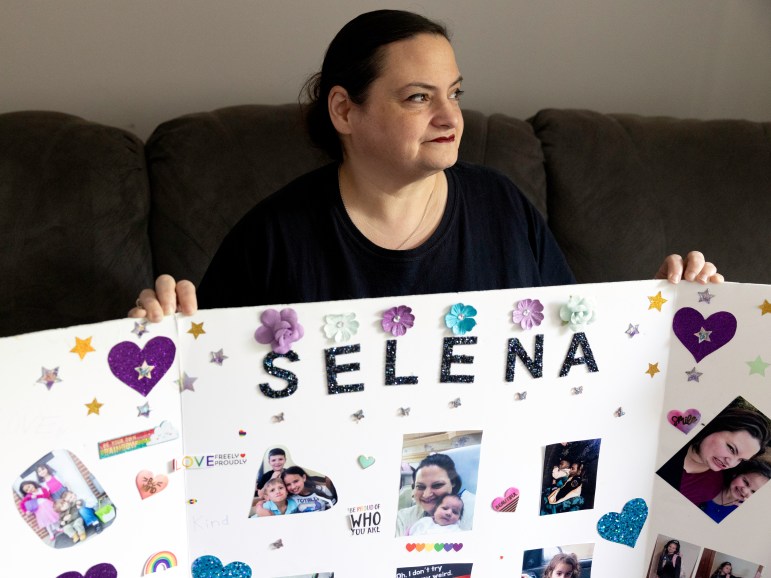 Tammy Rodriguez poses for a portrait with a posterboard of photos of her daughter Selena, that was on display at her funeral, at her home in Windsor on Thursday, June 25. After losing her 11-year-old daughter to suicide in 2021 Rodriguez was one of the first plaintiffs to join a lawsuit against social media companies. Credit: Sarah Gordon / CT Mirror
“Like they say, hindsight’s 20/20, but seeing where those addictive traits were coming out and how you wouldn’t have even thought that way,” she said. “Until they connected the two when I had gotten involved in this, [I] never would have put the two together.”
Rodriguez filed a lawsuit against social media companies like Meta and Snap, the parent company of Snapchat, in January 2022. She was the first person to file with the Social Media Victims Law Center. Her federal case is pending.
Shortly after, Rodriguez ramped up her involvement in these advocacy circles. She first traveled to Washington, D.C., in 2022 to meet with members of Congress. And she was one of the mothers holding up photos of their children as Meta CEO Mark Zuckerberg testified at an online safety hearing in 2024 and apologized to the families.
When reached for comment about Rodriguez’s lawsuit and KOSA, Snap reiterated its support for the federal legislation. Meta did not respond to a request for comment.
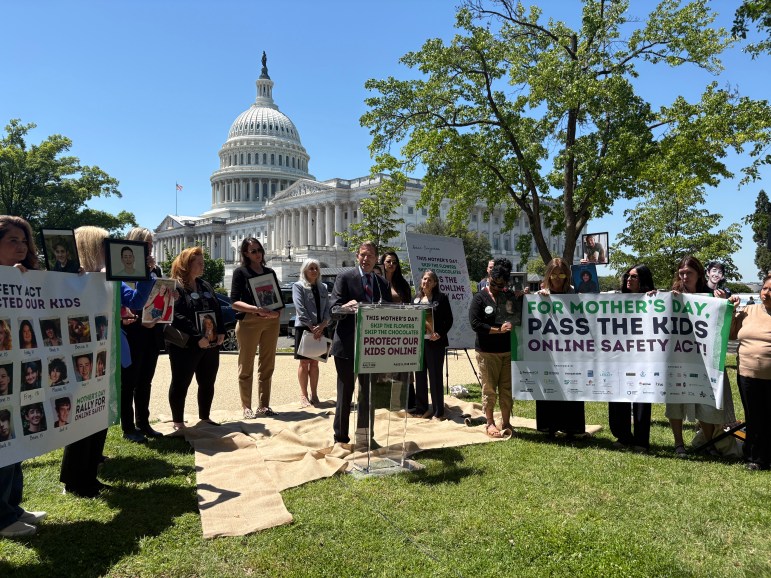 U.S. Sen. Richard Blumenthal, D-Conn., joined advocates at a May 12, 2026, rally to push for action on his version of the Kids Online Safety Act. Credit: Lisa Hagen / CT Mirror
Will there be a last-minute breakthrough on KOSA?
The overall issue of online safety, particularly regarding minors, is one of the few issues that defies traditional political ideologies. But even with an issue that’s garnered significant bipartisan support, Congress has still struggled to tackle it in recent years.
One of the biggest points of contention that’s divided the two chambers is over the “duty of care.” It would require companies to “exercise reasonable care” when designing a platform to mitigate a defined list of potential harms to minors, including certain mental health disorders, substance use disorders and physical and sexual abuse. The duty of care section has undergone multiple revisions throughout years of negotiations.
Critics of the Senate legislation have voiced concerns around free speech. Criticism has also stemmed from some LGBTQ+ advocates who argue it could ultimately limit access to critical services for vulnerable children and communities. (Other LGBTQ+ groups have dropped their opposition after a past revision to address concerns.)
Groups such as the Center for Democracy and Technology and Electronic Frontier Foundation argue the Senate’s KOSA would incentivize age verification systems and say Congress should instead pursue legislation more focused on things like data privacy and consumer protection.
“Legislative proposals that would enact meaningful data minimization restrictions and other data privacy protections either for everyone or, at a minimum, beginning with enhancing protections for children would help to address some of the root causes animating the concerns for kids’ safety online,” the Center for Democracy and Technology wrote in a letter ahead of the August hearing during which KOSA was up for consideration. The Senate Committee on Commerce, Science and Transportation ultimately approved KOSA through a unanimous voice vote at its Aug. 5 markup.
The House passed its own version over the summer as part of the Kids Internet and Digital Safety (KIDS) Act, which strips out the duty of care language. Supporters of the House bill cite potential First Amendment and censorship concerns.
Blumenthal vehemently opposes to the House’s efforts, noting that KOSA is focused on design and is “content neutral.”
Some tech companies have rallied behind KOSA. Snap, the parent company that owns Snapchat, led the pack along with X, formerly known as Twitter, and Microsoft.
But NetChoice, a tech trade association representing members like Meta and Snap, has lobbied against both the Senate and House versions of kids online safety legislation, arguing they threaten free expression and innovation.
A few hours after Blumenthal’s unanimous consent request to quickly pass KOSA, the Senate departed for a month-long recess, meaning no business will happen until after the Nov. 3 elections. Lawmakers will try again in the lame-duck session to see if they can get it done on an accelerated timeline. Supporters made a similar push in the lame duck session at the end of 2024 but ultimately fell short.
Blumenthal hopes to see action on KOSA in the lame-duck session. He said they got a “general commitment” but not a specific date for a vote. And while differences remain between the House and Senate, he said they’re speaking with tech companies to garner support for their version over the House’s KIDS Act.
“I’m feeling very hopeful because the focus on AI is building the momentum for the Kids Online Safety Act,” Blumenthal said in an interview from the Capitol earlier this week. “I think there will be a real push for it.”
When Congress returns post-election, they’ll have about a month to finish up any remaining work, which includes government funding, the annual defense policy bill and a slate of priorities that got pushed off until the final weeks. It remains to be seen how much can get done before a new session in January restarts the clock.
“If they can’t get this done, what does that say about our Congress? That says to me it’s pretty dysfunctional. They need to get it together. They should be able to pass a strong bill,” said Deb Schmill, another parent advocate whose 18-year-old daughter Becca died in 2020 after taking fentanyl-laced drugs purchased on social media. Schmill said her daughter suffered for years as a victim of revenge porn and sexual assault.
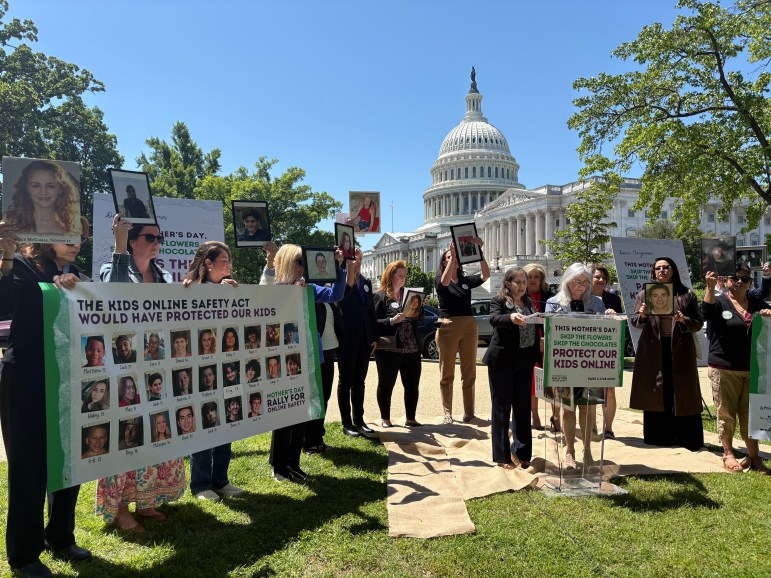 Parents, including Deb Schmill (left), advocate for the Kids Online Safety Act at a Mother’s Day rally held in D.C. on May 12, 2026. Credit: Lisa Hagen / CT Mirror
Focus on the courts
Even with the slim odds of getting it all done by the end of the year, advocates say they are seeing movement in the courts.
In a case this spring, a jury in California found Meta and YouTube liable in a social media addiction case. Around the same time, a jury in New Mexico found that Meta misled people about the safety of its apps.
Months later, Meta settled with Attorney General William Tong and dozens of other state attorneys general who had filed a multistate lawsuit against the company. As its piece of the settlement, Connecticut will get up to $265 million that will go to reducing youth harms on social media as well as programs like mental health and crisis intervention, after-school and summer school programming, and phone-free school zones.
On top of that, Meta, which did not admit to wrongdoing, will need to implement safety features for minors for at least the next five years including time limits with pauses after 15 minutes of continuous use of the apps, restrictions on access between midnight and 6 a.m. and limits on weekdays during the school year.
Rodriguez got to privately speak with Tong the day of the settlement’s announcement and was told advocates and parents like her would get a chance to give input and suggestions about how to allocate the funds. She said she’d like to see some of it go toward groups focused on mental health and education for teachers and staff on the signs to look out for.
 Bracelets on Tammy Rodriguez’s arm remember children who took their lives as she talks at her home in Windsor on Thursday, June 25. After losing her 11-year-old daughter to suicide in 2021 Rodriguez was one of the first plaintiffs to join a lawsuit against social media companies. Credit: Sarah Gordon / CT Mirror
States may get more money through the settlement, but it’s contingent on whether other social media platforms like Snapchat and TikTok agree to settle and implement the guardrails.
Meta called on others like YouTube and TikTok to adopt similar parameters for their platforms.
“But this framework will only work if all our peers join us,” Meta’s Chief Legal Officer J. Mahoney said in a video following news of the settlement. “Because teens move fluidly across dozens of apps, we need an industry-wide solution.”
Tong had a similar message for Meta’s counterparts.
“This is the largest settlement in American history with a single defendant, reflecting the magnitude of Meta’s misconduct and the unprecedented wealth they amassed from it,” Tong said in a statement. “But this has never been about money.”
“This settlement charts a new course for online safety, enforcing sweeping reforms to fundamentally alter the experience for kids on Instagram and Facebook,” he continued. “To TikTok, YouTube and Snapchat — our expectations are clear. You’re next.”
But Rodriguez is taking it one moment at a time. She feels like the resolutions in courts and the growing network of support signals to parents like her that people are “believing us, finally.” That propels them not to give up hope about passing legislation even if it remains unresolved heading into the next session of Congress.
“We’ve had so many new parents join this fight and join the parent networks. They have that beginning fire,” Rodriguez said. “Their fight is helping reignite our fight. So to us, it’s like we can’t stop because we now need to keep doing it for their kids.”
Courtesy of CT Mirror